Jérémy Digard's Portfolio | Applied Mathematics: from theory to impact
As a mathematician at EPFL, I explore how to apply theory to design robust systems for real-world problems. This site documents my technical case studies.
Decentralized Parametric Insurance
Investigation
To understand the reasons behind the failure of traditional agricultural insurance, I went into the field, to the 60-hectare fruit farm of SAS Le Rialet.
By analyzing the "paper" insurance contracts with the farmer, the problem became obvious: it wasn't a lack of data, but a lack of transparency. The trigger for reimbursement depended on subjective and often too slow human expertise.
The observation: The farmer doesn't need a promise of reimbursement, he needs a mathematical guarantee.
The Challenge: Connecting the Real World to the Blockchain
Here, the major challenge is data veracity. How do you bring a physical event, like a drought, into a closed digital system?
I designed a hybrid Oracle architecture:
- Hardware Security: Using AWS enclaves to certify that weather data has not been altered.
- Formal Logic (Move): Translating paper contract clauses (e.g., "if rain < 50mm") into an immutable Smart Contract.
Solution: Instant Protection
With Robin Sanders, we collaborated to make this complexity invisible. While I secured the backend architecture (Sui Blockchain), he designed a seamless interface allowing subscription in seconds.
The result is a functional Proof of Concept where:
- The user subscribes without a bank account (via zkLogin).
- They receive an NFT: their traceable insurance policy.
- In the event of a claim validated by the Oracle, the treasury (placed in DeFi to generate yields) triggers the transfer instantly.
Impact
Blockchain technology can serve a concrete social cause: the financial inclusion of unbanked populations (like Julius, a Malawian farmer cited in our research: see the Guardian article).
However, the real obstacle remains legal integration and the need for systemic reinsurance against climate risks.
Equissima – Schedule Optimization Algorithm
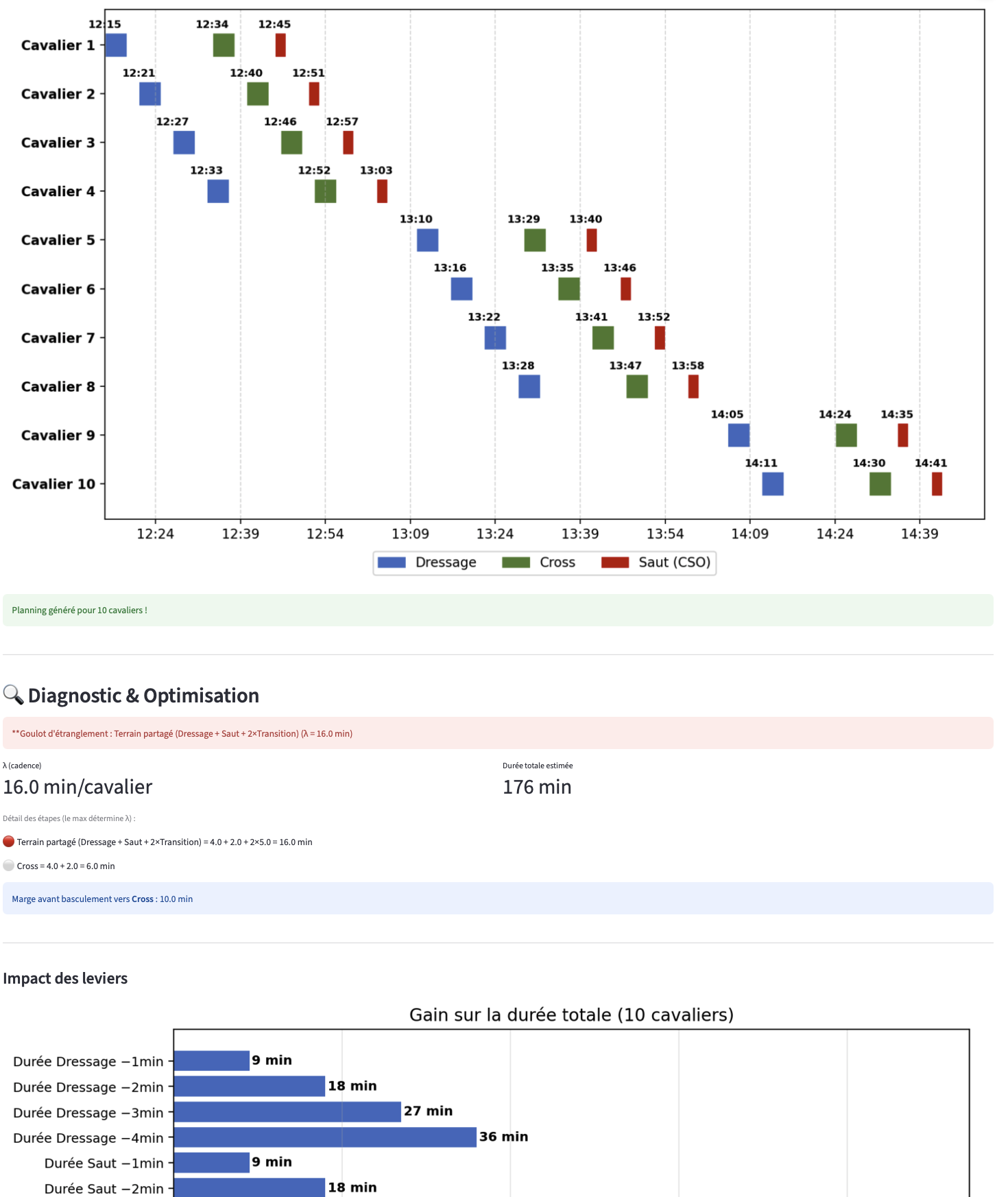
The Problem: A Logistical Chaos
Eventing is a logistical triathlon where riders chain three events with strict rest times. Until now, planning was manual and static. It was a fragile system: at the slightest fall or delay, the paper schedule became obsolete and impossible to recalculate live.
The challenge: How to mathematically guarantee the fluidity of the event without sacrificing the horses' well-being or the volunteers' peace of mind?
1. Understand before Solving
My first obstacle was contextual. I spent time with judges and organizers to understand the invisible constraints of the event.
This immersion taught me a lesson in humility: mathematical rigor is sterile if it is not rooted in empathy for the end users (the stress of a horse in the paddock, the time needed to "restore" a track).
2. The Translation Challenge: Identifying the Bottleneck
The second challenge was to translate these organic constraints (continuous flow, hazards) into a formal language. Classic simulations (O(N²)) were too slow for live use.
I changed the paradigm by modeling the competition as a Discrete Event System in Max-Plus algebra. (See the mathematical proof)
This approach allows for constant time resolution (O(1)) and offers a decisive advantage: automatic bottleneck detection. By calculating the system's eigenvalue, the algorithm immediately points out the critical resource (e.g., "it's the Dressage/Jumping transition that's blocking"), allowing for targeted optimization impossible to see with the naked eye. (View code)
3. The Impact: From Crisis Management to Serenity
The ultimate goal of this project is its social utility. The algorithm does not replace humans; it augments them by giving them back control.
By moving from reactive to proactive management, the software guarantees sporting fairness and reduces the mental load on volunteers.
Today, it is the only software capable of managing this specificity (the "No-Wait Flow Shop" with shared resources).
The solution is officially recommended by the concept's creator in the reference technical guide.
Live Detection of Ripe Apples
The Problem: The Inefficiency of "Search-and-Pick"
SAS Le Rialet manages 60 hectares of fruit production. During the apple harvest (Lady apples), the bottleneck is not the picking itself, but the decision: instantly identifying ripe fruits amidst the foliage (which requires training to know when a Lady apple is ripe).
Current autonomous harvesting solutions are too slow and too expensive.
The challenge: How to increase productivity and reduce the mental load on seasonal workers?
A detection model runs at about 15 FPS. However, to overlay information on reality without giving the user nausea, the display must refresh at over 60 FPS.
I developed a decoupling strategy:
- The "Slow" layer (AI): The vision algorithm (similar to YOLO-seg) analyzes the image periodically to identify ripe apples.
- The "Fast" layer (Spatial Computing): We use inertial sensors (IMU) and the glasses' 6DOF tracking to virtually "anchor" the result.
I ruled out VR solutions (too heavy, no peripheral vision) to focus on XREAL glasses (Optical See-Through).
Weight under 90g (for 8-hour shifts), outdoor brightness, and an SDK allowing spatial anchoring.
I contacted the manufacturer to propose an unprecedented industrial use case, in order to validate this architecture in real conditions (sun, dust).
It's not just about training an AI model, but understanding how to integrate it into a real-time data flow so that it is ergonomically viable for a human.
Real-time Detection of Internal Cognitive Structure
During my training in the Process Communication Model (PCM), one must identify the other person's personality structure and adapt their language to communicate well.
In practice, it is cognitively exhausting: trying to analyze your interlocutor's syntax while maintaining a fluid conversation leads to mental saturation. Even the trainer cannot listen, analyze, and correct ten students simultaneously.
The goal was to perform psychological analysis on a continuous, multi-speaker, live audio stream.
- Isolate the target user's voice from the others.
- Transcribe the stream into text with a sliding buffer.
- Perform instant psychological analysis (Llama).
Note: prosody analysis was ruled out because the performance gain is minor and only hume.ai's proprietary model allows it. The real gain lies in the AI model's understanding of PCM theory (which I am working on to create a fine-tuned, non-prompted model).
The main problem encountered is the Cocktail Party Problem: identifying the speaker's voice in a discussion. I solved it by using a sample of the speaker's voice recorded alone, placed at the beginning of the chunk inferred by MossFormer.
Analyzing a person's psychology is intrusive. Everything runs on my own servers, without external APIs, to protect the user.
The system works via WebSocket and provides real-time feedback (latency < 3s) to all learners/trainers at tiptopconseil.fr.
This project demonstrates that it is possible to combine AI models to create an educational tool that does not replace the trainer, but accelerates learning.
This architecture accelerates the learning of students in the PCM training center who have been using it since February 2026.
graph TB
    A[Audio 48 kHz] --> B(MossFormer - Separation)
    B --> C(WhisperX - Transcription)
    C --> D(Llama - Analysis)
    D --> E[User Feedback]